IR vs. RF Remotes for LED Strips: Why Your Lights Stop Responding From Across the Room
Posted by Raaiha Jannat
Filed in Business 11 views
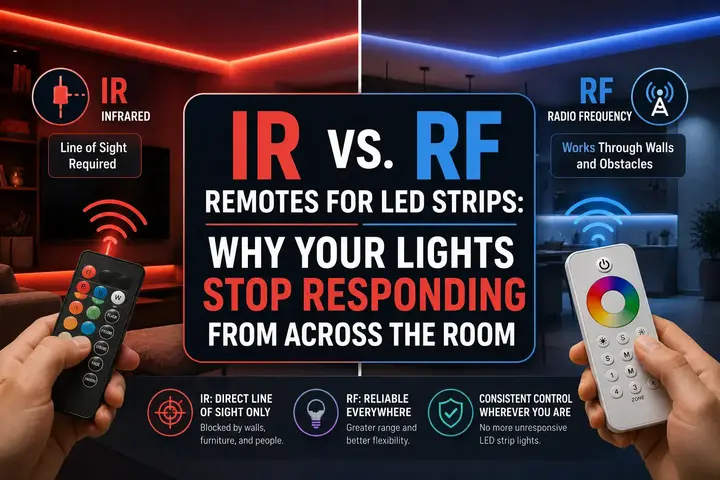
Anyone who's installed RGB LED strip lighting has probably hit this exact moment: you're standing in the doorway, remote in hand, pressing the button to change the color, and nothing happens. Walk closer, point the remote directly at a tiny sensor tucked behind the cabinet or under the shelf, and suddenly it works fine. That inconsistency isn't a defective remote or a wiring issue. It's almost always a fundamental limitation of the remote technology itself, and it's one of the most common, most avoidable frustrations in LED strip installations.
The real difference between IR and RF isn't range, it's line-of-sight
Most budget LED strip kits ship with infrared, or IR, remotes, the same basic technology used in most TV remotes. IR works by sending a beam of infrared light from the remote to a small receiver "eye" on the controller. That beam has to travel in a fairly direct, unobstructed line to be picked up, which means the receiver has to be visible, or nearly visible, to wherever you're standing when you press the button.
This is fine in a small, open room where the receiver sits in plain sight. It falls apart quickly in more realistic installation scenarios:
-
Under-cabinet lighting, where the receiver is tucked behind cabinetry and effectively invisible from most angles in the kitchen.
-
Cove lighting, recessed into a ceiling channel where there's no clean line of sight from normal standing height.
-
Multi-room or open-plan spaces, where you want to adjust lighting from an adjacent room or hallway.
-
TV backlighting, where the receiver is mounted flush against the wall behind the television, one of the worst possible spots for a line-of-sight signal.
In every one of these setups, an IR remote will work intermittently at best, technically functional but frustrating enough that most people just stop bothering to adjust the lighting after the first few weeks.
RF solves this by changing how the signal actually travels
Radio frequency, or RF, remotes work on a completely different principle. Instead of a beam of light that needs a clear path, RF sends a radio signal, the same general category of wireless communication used by garage door openers and car key fobs, which passes through walls, cabinetry, and other obstacles without needing a direct line of sight. A receiver hidden behind a cabinet, inside a ceiling channel, or across a room will pick up the signal just as reliably as one sitting in plain view.
This is the single biggest practical difference between the two technologies, and it's usually the reason people upgrade after living with an IR-based kit for a while. It's not about the remote looking nicer or having more buttons. It's that the lighting actually responds consistently regardless of where you're standing or where the strip is installed.
What to check before buying an RF controller
Not all RF kits are built the same, and a few specs matter more than people expect when comparing options:
-
Frequency band. 2.4GHz is the current standard for reliable RF lighting control, offering better range and less interference than older sub-1GHz systems.
-
Control range. Look for something rated around 30 meters for realistic whole-room or multi-room coverage, since actual usable range is always somewhat less than the rated maximum once walls and furniture are factored in.
-
Max load and channel current. RGB strips draw more power than single-color strips, since they're really three separate color channels running simultaneously. A controller needs to be rated for the combined draw of your total strip length, not just a single channel.
-
Voltage compatibility. Confirm the controller supports your strip's actual voltage, most commonly 12V or 24V DC, since running the wrong voltage through a controller not rated for it is a fast way to damage both.
What this looks like as an actual upgrade
For anyone dealing with unreliable IR control on an existing installation, or planning a new one where the receiver will inevitably end up hidden behind cabinetry or in a ceiling channel, swapping to a proper RF setup solves the problem directly rather than working around it. A kit like the RF 2.4G Wireless RGB LED Strip Controller Kit is a straightforward example of what to look for: 2.4GHz operation with a 30-meter range that doesn't require line-of-sight, a touch-wheel remote for smoother color selection than the small button grids on most stock kits, and enough load capacity, 144W at 12V or 288W at 24V, to handle a genuinely long strip run rather than just a short accent piece.
A quick troubleshooting check before assuming you need new hardware
If lights are responding inconsistently right now, it's worth ruling out the simple stuff first: fresh remote batteries, confirming the receiver isn't physically blocked by metal (which can interfere with both IR and, to a lesser extent, RF signals), and checking that the remote and receiver are actually paired correctly per the manual. But if the pattern is specifically "works up close, fails from across the room or around a corner," that's a line-of-sight problem baked into the technology itself, not something a battery swap or re-pairing will fix. At that point, moving to RF isn't really an upgrade in the luxury sense, it's fixing a limitation that was there from day one.