HIIT vs Cardio: Actual Calorie Burn, Fat Loss, and Which Is Better
Posted by Dawn Munro
Filed in Health 12 views
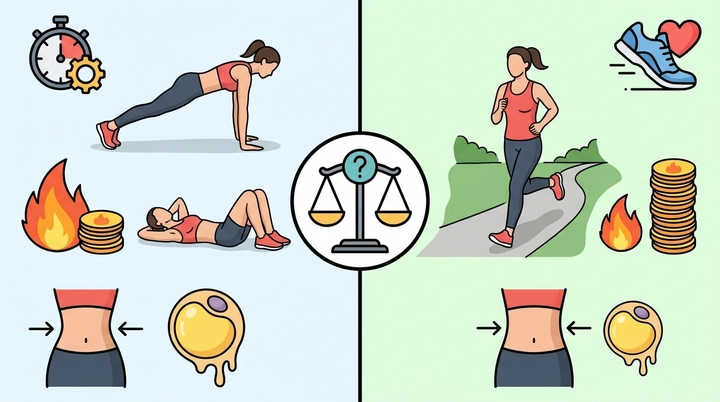
The fitness industry is flooded with conflicting advice regarding energy expenditure and fat loss. The hiit vs cardio debate remains one of the most discussed topics among athletes, coaches, and everyday fitness enthusiasts. When time is limited and results are demanded, choosing between hiit or cardio can dictate your physical progress for months. To make an informed decision, you must bypass marketing claims and examine physiological data, metabolic equivalents, and actual energy system mechanics. This comprehensive breakdown of hiit vs cardio provides the exact numbers, scientific mechanisms, and practical applications you need to optimize your training routine.
The Physiological Divide: Energy Systems and Muscle Fibers
To fully understand the hiit vs cardio comparison, you must first look at how the human body generates energy. The body utilizes three primary energy systems: the ATP-PC system, the glycolytic system, and the oxidative system.
When examining hiit vs Traditional cardio, the oxidative system dominates traditional cardio. Steady-state aerobic exercise primarily recruits Type I (slow-twitch) muscle fibers. These fibers are highly resistant to fatigue and rely on oxygen to metabolize fats and carbohydrates for sustained energy. Your heart rate remains in Zone 2 or Zone 3, allowing you to exercise for extended periods.
Conversely, HIIT relies on the ATP-PC and glycolytic systems. By pushing your heart rate into Zone 4 and Zone 5, you recruit Type II (fast-twitch) muscle fibers. These fibers generate immense power but fatigue rapidly. They operate without oxygen (anaerobically), utilizing stored glycogen for quick bursts of energy.
In the hiit vs cardio matchup, traditional cardio builds mitochondrial density and capillary networks, improving your aerobic base. HIIT increases VO2 max and anaerobic threshold. Both are necessary for complete cardiovascular health, but they trigger completely different metabolic adaptations.
The Calorie Math: Actual Energy Expenditure
The most common question in the hiit vs cardio discussion revolves around energy expenditure. People want exact numbers and track their hiit calories burned meticulously. Caloric burn is calculated using Metabolic Equivalent of Task (METs). One MET equals the energy expended at rest. Steady-state jogging is roughly 7 METs, while intense interval training can push 10 to 12 METs.
If you are wondering how many calories does hiit burn, the answer depends on your body weight and the exact intensity of your intervals. A 160-pound individual will burn approximately 12 to 15 calories per minute during maximum exertion.
Here is the exact breakdown of how many calories hiit workout burn for a 160-pound person maintaining high intensity:
- 10 Minutes: If you want to know how many calories does a 10 minute hiit workout burn, expect to expend between 120 and 150 calories.
- 20 Minutes: For those tracking how many calories does a 20 minute hiit workout burn, the total expenditure sits between 240 and 300 calories.
- 30 Minutes: How many calories does a 30 minute hiit workout burn? A properly structured session will yield 360 to 450 calories.
- 45 Minutes: The 45 min hiit calories burned range for a 160-pound person falls between 540 and 675 calories.
If your body weight is higher, the energy required to move increases. A 200-pound person will see a 25% increase in all these metrics. Therefore, when asking how many calories do you burn in a high intensity workout, you must factor in body mass. The calories burned during hiit average 10 to 15 calories per minute for most adults. This data explains how many calories does a high intensity workout burn and how it scales with time.
When tracking overall hiit workout calories burned, it is clear that the intensity directly dictates the output. This data provides the baseline for how much does hiit burn and how much does a hiit workout burn during a single session.
Comparing Modalities: Running and Class Settings
Another major focal point of the hiit vs cardio debate is how intervals compare to the most popular form of cardio: running. A frequent question is, does hiit burn more calories than running?
Running at a moderate 6 mph pace burns about 10 calories per minute. A high-intensity interval burns 12 to 15 calories per minute. Therefore, do hiit workouts burn more calories? Yes, when comparing minute-to-minute exertion.
Does hiit burn more calories overall? It depends on the duration. A 30-minute interval session can match the caloric output of a 45-minute steady-state run. This efficiency is why a hiit class calories burned receipt often surprises treadmill regulars who are accustomed to spending an hour on a single machine.
However, sustainability plays a role. While intervals burn more per minute, most people cannot sustain that intensity for 60 minutes. You can run or cycle at a moderate pace for an hour, accumulating total volume. In the hiit vs cardio discussion, steady-state allows for a higher total volume of work, while intervals offer higher caloric density.
EPOC and Fat Oxidation
If you calculate the numbers above, you might notice that a 30-minute run and a 30-minute interval session do not have a massive disparity in immediate caloric burn. This leads to the critical question: why does hiit burn more fat?
The answer lies in Excess Post-exercise Oxygen Consumption (EPOC), commonly referred to as the afterburn effect. When you perform steady-state cardio, your metabolism returns to its resting state within minutes of finishing the workout. EPOC is minimal.
During high-intensity efforts, your body creates a significant oxygen deficit. Your muscles deplete glycogen stores, accumulate lactate, and experience micro-tears. Post-workout, your body requires massive amounts of oxygen to restore normal cellular function, resynthesize ATP, clear lactate, and normalize body temperature.
Research indicates that EPOC can elevate your resting metabolic rate by 5% to 15% for up to 24 to 48 hours post-exercise. This means you continue burning additional calories while sitting on the couch or sleeping.
When asking are hiit workouts better than cardio for strict fat loss, the EPOC effect gives intervals a distinct advantage. The metabolic disturbance is greater, leading to higher overall fat oxidation over a 24-hour window. However, in the hiit vs cardio debate, steady-state remains superior for beginners, individuals with joint issues, or those building an aerobic base without central nervous system fatigue.
Specific Movements vs. Entire Workout Formats
A common point of confusion arises when people compare specific exercises to entire training methodologies. For example, evaluating mountain climbers vs hiit is a categorical error.
You cannot accurately weigh hiit vs mountain climbers because mountain climbers are a single movement pattern, whereas HIIT is a workout structure. Mountain climbers are a phenomenal exercise utilized within a high-intensity protocol. They engage the core, shoulders, and hip flexors while driving the heart rate into anaerobic zones almost instantly.
In the context of the hiit vs cardio decision, you must look at the entire structure. Mountain climbers can be performed slowly, making them a strength or mobility exercise, or explosively, making them a high-intensity interval. The format dictates the metabolic response, not the isolated movement.
Practical Application: Structuring Your Routine
Understanding the physiological facts behind hiit vs cardio allows you to build a scientifically sound training schedule. If your primary goal is maximum fat loss in minimal time, intervals are superior due to caloric density and EPOC. If your goal is building an aerobic engine, improving recovery, or protecting joint health, steady-state cardio is highly effective.
For optimal physical conditioning, metabolic health, and injury prevention, experts recommend a hybrid approach. A balanced week might include two days of high-intensity intervals to stimulate fast-twitch fibers and maximize EPOC, paired with two days of steady-state cardio to build the aerobic base and promote active recovery. This prevents overtraining and ensures both energy systems are adequately stressed.
For individuals seeking structured guidance and a community environment to maintain accountability, joining a Womens Fitness Bootcamp provides an ideal solution. Bootcamps are professionally programmed to rotate between high-intensity interval blocks and steady-state cardiovascular circuits, ensuring you reap the metabolic benefits of both modalities without having to design the programming yourself.
Stop Guessing and Start Training
The data is clear: both modalities have distinct physiological benefits, but they must be applied correctly to see actual results. If you want to experience the precise caloric expenditure and metabolic afterburn of a professionally structured routine, you need a program built on exercise science, not guesswork.
Stop wasting time on ineffective workouts that do not move the needle. Take control of your fitness journey today. Click here to claim your free pass to our local training program and experience the exact metabolic protocols used to burn fat and build endurance. Bookmark this guide, share it with a friend to build your accountability team, and start applying these facts to your routine immediately.