Are Your Employees Actually AI-Fluent, or Are They Just Copy-Pasting?
Posted by Custom boxes
Filed in Business 18 views
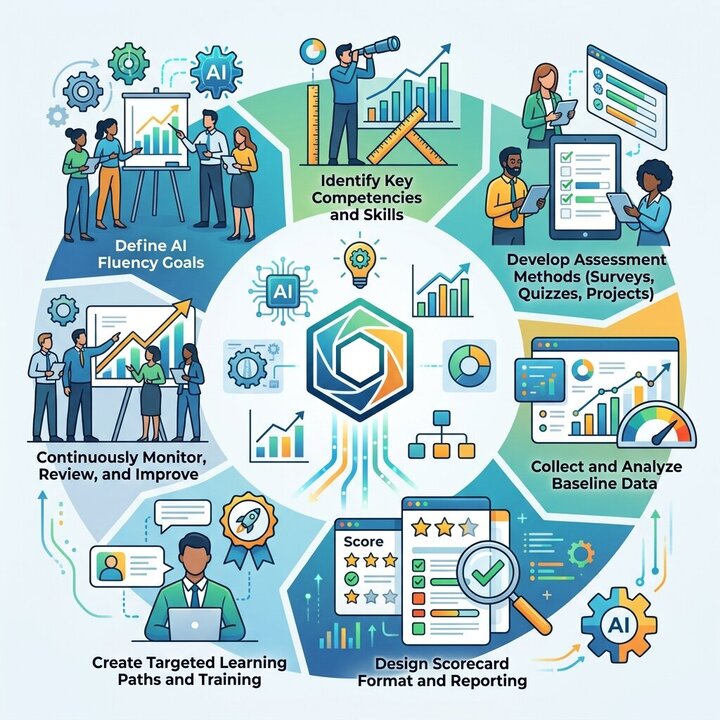
In the current corporate landscape, a silent friction is brewing. Organizations are rapidly rolling out generative AI licenses, embedding tool usage into performance reviews, and tracking employee token consumption. On paper, digital transformation is soaring. In reality, business leaders are running into a frustrating paradox: the AI adoption gap.
According to recent workplace data, while over 70% of business leaders use AI weekly, fewer than half of their employees do. Even when employees do use AI, many fall into the "spray and pray" trap—using technology for the sake of technology without producing better outcomes.
The diagnosis? It isn’t an access problem. It is an AI Fluency problem.
True AI fluency is not about knowing which buttons to click or hoarding an unorganized list of prompts. It is a systematic, structured cognitive framework. To build an AI-first organization, modern HR leaders are shifting their training programs to target the industry-standard AI Fluency Framework. Developed by academic experts in partnership with Anthropic, this framework outlines the 4Ds of AI Fluency.
Here is how HR departments are rewriting their upskilling playbooks to turn standard employees into highly capable, AI-fluent professionals.
What are the "4Ds" of the AI Fluency Framework?
To move past basic software literacy, employees must master four interconnected cognitive competencies. These are the 4Ds: Delegation, Description, Discernment, and Diligence.
By categorizing workforce training around these four dimensions, HR teams can transition employees from passive users into strategic co-pilots.
1. Delegation: Knowing When to Partner with AI
Before a single word is typed into an LLM, an employee must possess Delegation competency. This involves setting clear goals and making a conscious, calculated decision on whether, when, and how to use AI for a task.
Anthropic
-
The Skill: Analyzing a workflow, identifying repetitive or low-leverage cognitive tasks, and selecting the optimal AI tool or platform.
-
The Trap: Delegating tasks that require high-stakes human empathy, strategic brand alignment, or absolute factual accuracy without a human-in-the-loop.
2. Description: Communicating Intention with Precision
Once a task is designated for AI, the user must execute Description. This is the practical execution of prompt engineering—translating human objectives into a language the AI can accurately process.
Anthropic
-
The Skill: Structuring instructions with clear context, role-play constraints, formatting instructions, and explicit step-by-step processes.
-
The Trap: Writing vague, one-sentence prompts (e.g., "Write an HR report"), which forces the AI to hallucinate details and return generic, low-value content.
3. Discernment: Evaluating Outputs with a Critical Eye
Perhaps the most missing skill in the modern workforce is Discernment. Employees often suffer from automation bias, accepting AI-generated outputs at face value. Discernment is the ability to critically analyze, audit, and refine what the AI produces.
-
The Skill: Fact-checking dates, validating data logic, editing tone, spotting subtle biases, and determining if the output meets professional standards.
Open Courses -
The Trap: Blindly copy-pasting an unverified AI draft directly into client-facing deliverables or internal SOPs.
4. Diligence: Taking Accountability for the Final Result
Diligence is the ethical and operational guardrail of the framework. It dictates how an employee uses AI responsibly, safely, and transparently.
Open Courses
-
The Skill: Protecting proprietary company data, maintaining compliance with privacy laws, acknowledging AI assistance transparently, and taking full personal accountability for the final work product.
-
The Trap: Uploading sensitive employee records or protected client data into public consumer-grade AI platforms.
How Do Employees Move Between the Three Modes of AI Interaction?
AI fluency does not look the same for every task. To align workforce talent effectively, HR teams must help employees understand how to shift between three distinct modes of human-AI collaboration:
|
Mode of Interaction |
How It Works |
HR/Productivity Example |
|
Automation |
AI executes highly specific, pre-defined tasks based on direct human commands. |
Generating standard interview confirmation emails or parsing candidate resumes for specific keywords. |
|
Augmentation |
Humans and AI collaborate interactively as active "thinking partners" to solve a problem. |
Brainstorming creative employee engagement strategies or structurally mapping out a new training curriculum. |
|
Agency |
Humans configure AI agents to work independently and make decisions on their behalf over time. |
Deploying an AI scheduler that independently coordinates complex calendar bookings across global teams. |
Why Is HR Shifting From "Usage Metrics" to "Fluency Metrics"?
When organizations first introduced generative AI, they rewarded pure activity. Leaders built dashboards tracking how many times developers utilized AI copilots, or celebrated teams for generating thousands of marketing assets overnight.
However, this metric-driven push backfired. Tech giants like Amazon saw developers automating non-essential tasks simply to raise their internal leaderboard rankings, leading to rising API token costs and a spike in AI-induced technical errors that required human intervention to fix.
Today, forward-thinking CHROs realize that the goal isn't to make employees use AI more; it is to make them use it smarter. When performance reviews evaluate workers on their contextual application, critical editing skills, and safe data habits, the organization saves money, protects its brand, and boosts genuine productivity.
How Can HR Leaders Practicalize AI Fluency?
Building a highly fluent workforce requires a structured, human-centric strategy. HR departments can implement these four actionable steps to get started:
HR News
-
Reframe the Mandate from "Output Volume" to "Work Quality": Explicitly instruct your teams that AI is a tool to elevate the depth, accuracy, and technical quality of their output—not just a tool to finish their day's tasks in ten minutes.
-
Document and Shared Prompt Libraries: Establish structured Standard Operating Procedures (SOPs). Instead of leaving employees to guess how to prompt, build an organizational repository of verified, vetted prompts for repeatable business tasks.
TriNet -
Invest in "Applied Learning" Over Theory: Eliminate abstract training courses. Shift your L&D budget toward hands-on workshops, simulated sandbox environments, and peer-to-peer coaching where employees can apply AI tools to their immediate, real-world tasks.
HRTech Series -
Create "AI Research Labs": Dedicate a small, structured amount of weekly time for employees to experiment with emerging workflows, with the requirement that they present their findings to the team.
By standardizing AI Fluency through the lens of Delegation, Description, Discernment, and Diligence, organizations can build an agile, future-proof workforce that doesn't just use modern technology—but genuinely understands how to partner with it.read more:hr tech news today