MCA Master Data for Credit Risk Analysis: Key Fields That Matter
Posted by Anushree Sharma
Filed in Other 13 views
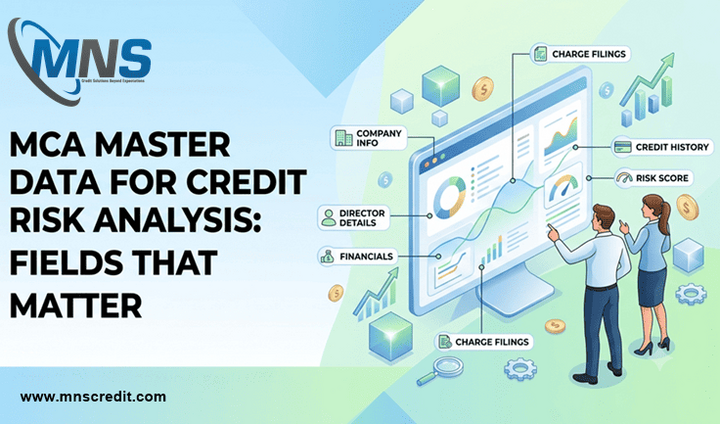
Credit risk analysts working on Indian counterparties rarely start from a blank slate. Before financial ratios are calculated or a credit line is proposed, MCA Master Data provides a set of structural and behavioural fields that shape the entire risk narrative. Understanding exactly which fields matter, and why, separates a superficial company search from a genuine input into a credit decision.
CIN: The Anchor for Every Other Check
The Corporate Identification Number is more than an identifier — it encodes the company's listing status, industry classification, state of registration, year of incorporation, and company type in a single string. For credit analysts, the CIN is the anchor that every subsequent check is built around, since it eliminates ambiguity between similarly named entities. Group structures frequently include multiple companies with near-identical names operating in different states or sectors, and confirming the exact CIN before any credit exposure is assigned prevents the common and costly error of evaluating the wrong legal entity.
Company Status: The First Filter in Any Credit Decision
Registration status is the single fastest disqualifying or reassuring signal in the dataset. 'Active' status confirms the entity is legally permitted to operate and enter contracts. Statuses such as 'Strike Off', 'Dormant', 'Under Process of Liquidation', or 'Active - Non-compliant' should trigger an immediate hold on any new credit exposure until the reason is understood. A company under liquidation or struck off the register cannot meaningfully honour credit terms, regardless of how strong its trading relationship or invoices might appear.
It is worth noting that status changes are not always permanent or negative in isolation — a dormant company may be a genuine shell awaiting a specific transaction, and a strike-off can sometimes be reversed through NCLT restoration. What matters for credit risk purposes is that status is checked at the time of underwriting and again periodically, since a counterparty's standing can change materially between an initial credit approval and a subsequent renewal.
Director and Designated Partner Details
Director information supports two distinct credit risk functions. First, it confirms who has the legal authority to bind the company in agreements, which matters when a personal guarantee or authorised signatory verification is part of the credit structure. Second, and more valuable analytically, cross-referencing a director's DIN against other companies they are associated with can surface a pattern — multiple entities linked to the same individual carrying strike-off status, filing defaults, or disqualification flags is a meaningful red flag that a single-entity search would miss entirely.
Director disqualification under Section 164 of the Companies Act is a particularly important check. A disqualified director cannot be reappointed or continue in office at other companies for a defined period, and credit analysts who spot this early can avoid extending exposure to an entity whose leadership is legally compromised.
Charges: Reading a Company's Existing Leverage
The charges register is arguably the most underused field in credit risk analysis, yet it is one of the most revealing. It lists every charge created against company assets in favour of lenders, including the charge amount, the date created, and whether it has been satisfied. For a credit analyst, this is a direct window into a company's existing secured borrowing — information that is not always fully disclosed in a borrower's own credit application.
A company with several open, unsatisfied charges against its fixed and current assets has less unencumbered collateral available than its balance sheet might suggest, which directly affects loss-given-default assumptions. Charges that appear to have been created and never marked satisfied despite the company's claim of repayment also warrant direct clarification — either the satisfaction filing was simply missed administratively, or the debt genuinely remains outstanding.
Filing History: A Proxy for Financial Discipline
Annual return and financial statement filing history (MGT-7 and AOC-4) is a behavioural indicator as much as a compliance one. Companies that file consistently and on time tend to maintain more disciplined financial reporting practices generally. Persistent late filing or multi-year gaps often correlate with weaker internal controls, management turnover, or financial distress that has not yet become public in other ways.
For credit risk teams building an internal scoring model, filing regularity is a low-cost, easily automatable input that adds genuine predictive value alongside traditional financial ratios. It is also one of the earliest available signals — a filing gap can appear well before a company misses a payment or shows up in a default database.
Bringing the Fields Together in a Credit Decision
No single MCA field determines a credit decision on its own. The value comes from reading CIN, status, director history, charges, and filing behaviour together as a composite picture, then layering that picture against financial statement analysis and payment history. This is the same structured approach reflected in a well-built Business Information Report, where master data verification, financial analysis, and credit history are consolidated into a single underwriting input rather than assessed in isolation.
Analysts who treat MCA Master Data as a genuine risk input — not a one-time onboarding formality — build stronger, more defensible credit files and catch deterioration in a counterparty's standing earlier than those who rely on financial statements alone.
Re-Checking Fields Over the Life of a Credit Relationship
Credit risk analysis is too often treated as a point-in-time exercise performed at underwriting and rarely revisited until a renewal date arrives. MCA fields, by contrast, change continuously — a company's status can move from Active to Non-compliant, a new charge can be created against previously unencumbered assets, or a director can be disqualified, all within a single credit cycle. Building periodic re-checks of these fields into portfolio monitoring, rather than only at origination, allows credit teams to catch deterioration in a counterparty's standing well before it appears as a missed payment.
This is particularly relevant for revolving credit lines and long-tenor trade relationships, where the gap between initial underwriting and the next formal review can stretch over a year or more. A quarterly or semi-annual automated check against status, filing currency, and new charges is a low-effort control that meaningfully tightens portfolio-level risk monitoring without requiring a full re-underwriting exercise each time.
For lenders and trade credit providers managing large counterparty books, this kind of systematic field-level monitoring is also what makes early-warning systems genuinely early. By the time a deteriorating company appears in a default database or a public litigation record, the credit exposure has often already been extended at the original, now-outdated risk assessment. Catching a status change, a new charge, or a filing lapse while the relationship is still being actively managed gives credit teams room to adjust terms, request additional security, or reduce exposure before a loss event occurs.