How Custom Packaging Helps Small Businesses Compete with Big Brands
Posted by mary donna
Filed in Business 11 views
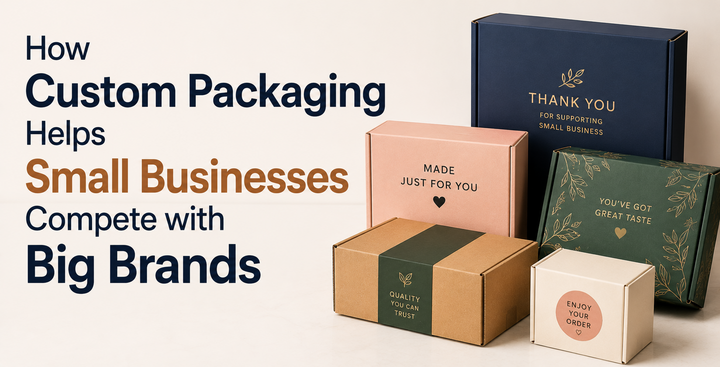
Small businesses compete against larger rivals with more money, more staff, and more reach in nearly every arena. But there's one arena where the playing field is surprisingly level — and where a small brand can even win outright: packaging. The box a customer opens doesn't announce how big the company behind it is. It only announces how much that company cared. And care is something a small business can deliver in abundance.
Here's how custom packaging helps small businesses punch above their weight and compete with the giants.
Packaging hides company size
When a customer receives a well-designed, considered package, they have no way of knowing whether it came from a hundred-person operation or a founder working from a spare room. The package looks professional, so they assume the business is professional. Perceived scale and credibility come from the experience, not from any visible headcount.
This is a genuine advantage. A small business that invests in packaging can present itself as established and trustworthy from the very first order, closing the credibility gap with larger competitors before the customer knows the difference.
Low minimums have removed the old barrier
Custom packaging used to be a big-company privilege because it required huge order volumes. That barrier has largely fallen. Flexible production and low or no minimum orders mean a small business can now get genuinely custom, branded packaging without committing to warehouse-filling quantities.
This matters enormously. Options like no-minimum custom packaging let a growing brand order what it actually needs, test designs, and scale up as demand grows — all without the upfront risk that used to lock smaller players out. The result is that the professional, branded experience customers expect is now within reach of businesses of any size.
Care beats budget in the details
Large brands operate at scale, and scale often means standardisation and distance from the individual customer. Small businesses can do the opposite — and packaging is where that difference shows. A personal thank-you note, a hand-added touch, packaging chosen with genuine thought — these are easier for a small team that's close to its customers.
Customers feel the difference. A package that feels personal and considered creates an emotional connection that a mass-produced, impersonal one can't match. Where a small business can't win on budget, it can win on care, and packaging is one of the most visible places that care lands.
Packaging turns customers into advocates
Small businesses live and die by word of mouth, and packaging is one of the most reliable ways to earn it. A delightful unboxing experience is inherently shareable — customers photograph it, post it, and recommend the brand to others. For a small business without a big advertising budget, that organic advocacy is invaluable.
A large brand can buy reach. A small brand can earn it by making every delivery worth sharing. Custom packaging turns each customer into a potential marketer, extending the brand's reach far beyond what its ad budget could buy.
Consistency builds a real brand
One of the ways big brands maintain dominance is through consistency — customers recognise them instantly and trust the familiarity. Small businesses can build the same asset. Consistent, branded packaging across every order makes a small brand recognisable and memorable, turning scattered transactions into a coherent brand identity.
Over time, this consistency compounds. Each package reinforces the last, and the small brand starts to feel established and reliable — not because it's large, but because it's consistent. That perception of a "real brand" is something custom packaging helps build directly.
Standing out on a crowded shelf or doorstep
Whether the competition is on a retail shelf or arriving at the same doorstep, distinctive packaging helps a small business stand out against larger, more generic competitors. Big brands can become complacent, relying on name recognition and shipping in unremarkable packaging. A small brand with distinctive, considered packaging can capture attention and stick in memory precisely because it looks like it tried.
Standing out is often more valuable for a small business than for a large one, because the small business has less name recognition to fall back on. Packaging is one of the most affordable ways to earn that distinctiveness.
Sustainability as a competitive edge
Customers increasingly care about environmental responsibility, and small businesses can often move faster than large ones to adopt sustainable packaging. Recyclable, right-sized, honestly labelled packaging signals values that resonate with customers — and a nimble small brand can make that shift without the inertia of huge existing contracts.
This turns sustainability into a competitive edge. A small brand that packages responsibly and says so honestly can win the trust of values-driven customers that a slower-moving giant may be struggling to earn.
Making it work on a small-business budget
Custom packaging as a competitive tool doesn't require a large budget — it requires intention. Practical starting points:
-
Start with low-minimum custom options so you can brand your packaging without overcommitting.
-
Right-size your packaging to save cost and reduce waste from day one.
-
Add personal touches that larger competitors can't easily replicate.
-
Stay consistent so every order builds recognition.
-
Make the experience shareable to turn customers into advocates.
The takeaway
Packaging is one of the few arenas where a small business can genuinely out-compete a much larger rival. It hides the size gap, signals professionalism and care, earns word of mouth, and builds a recognisable brand — all without requiring a giant budget. Now that low minimums have removed the old barrier to entry, custom packaging is one of the smartest investments a small business can make to look, feel, and compete like a brand far bigger than it is.