A Complete Guide to AI and ML Services for Modern Enterprises
Posted by Christine Shepherd
Filed in Technology 23 views
Almost a decade ago, you could leave AI to your IT department. But that's not the case anymore. You need to ask about it the way you once asked about the cloud. The question is not whether to invest in technology, but how quickly you can make a move without breaking something important along the way.
The scale of that shift shows up in numbers. McKinsey's 2025 State of AI survey found that 88% of organizations now use AI regularly in at least one business function, a sharp jump from the year before. Yet only a small slice of that group can point to measurable profit gains from it. Adoption has become routine. Turning it into value has not.
That gap, between using AI and actually profiting from it, is the reason enterprises need a working understanding of what AI and ML services really cover, where they pay off, and what it takes to get them right.
Getting the basics right first, let's understand the difference between AI and ML. Though the two terms get used interchangeably and they're surely related, they are not the same thing. And the table below clearly shows the difference:
|
Aspect |
Artificial Intelligence |
Machine Learning |
|
What Is It? |
The broad goal of building systems that can perform tasks normally requiring human judgment |
A specific method for reaching that goal, where systems learn patterns from data |
|
How Does It Work? |
Can use rules, logic, or learned patterns, or a combination |
Learns entirely from data, without being explicitly programmed for every scenario |
|
Example |
A chess engine using pre-set rules, or a fraud system that learns on its own |
A model that improves its fraud detection accuracy as it sees more transactions |
|
Relationship |
The umbrella category |
A subset of AI, every ML system is AI, but not every AI system is ML |
Now you must be wondering where generative AI and deep learning fall. Deep learning lives inside machine learning and uses layered neural networks to make sense of unstructured data. Generative AI comes out of deep learning too, except that instead of classifying or predicting, it creates something new. For example, text, a design draft, a first pass at code.
What Do AI and ML Services Include?
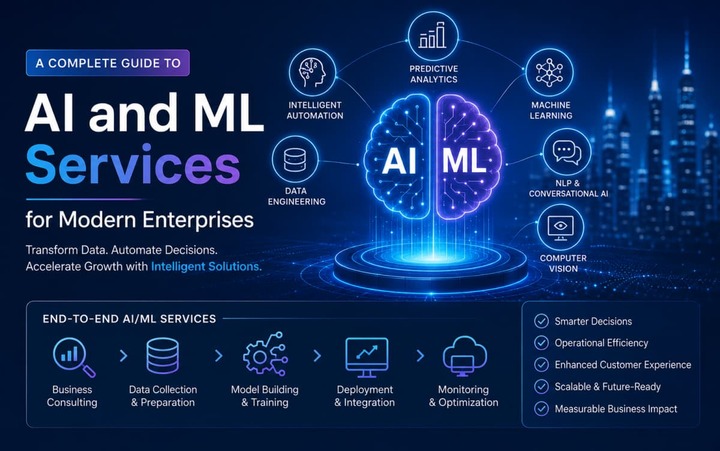
AI and ML services span the whole journey from idea to working system. Enterprises that engage with only one link in this chain usually end up with a pilot that never comes out of the demo stage.
1. AI Consulting and Strategy
Every successful AI initiative begins with a clear business objective. AI consulting helps organizations identify high-value use cases, assess data readiness, define success metrics, and create a roadmap aligned with business priorities.
For example, a manufacturing company may initially plan to implement AI across all operations. Through strategic assessment, it may be discovered that predictive maintenance offers the fastest return on investment, making it the ideal starting point.
2. Data Engineering and Model Development
AI systems are only as effective as the data they learn from. Data engineering focuses on collecting, cleaning, integrating, and organizing information from multiple sources to create reliable datasets for model training.
Imagine a retailer storing customer information across its website, mobile app, and CRM platform. Before building an AI model for personalized marketing, these datasets must be consolidated and standardized to ensure consistency and accuracy.
3. Applied Capabilities
This is the build itself. Predictive models, natural language processing, computer vision, and intelligent automation are shaped around a specific business function rather than deployed as a generic tool.
4. MLOps and Model Lifecycle Management
Deploying a machine learning model is only the beginning. Business environments evolve, customer behavior changes, and data patterns shift over time.
MLOps establishes standardized processes for deploying, monitoring, updating, and governing machine learning models throughout their lifecycle. Continuous monitoring ensures models remain accurate, secure, and aligned with changing business requirements.
Without ongoing management, even well-performing models can gradually lose effectiveness as new data differs from the information used during training.
Put those together, and AI stops being a buzzword and starts being a working system. The obvious next question is where these capabilities actually show up in day-to-day operations.
What Are the Common AI ML Solutions Driving Business Transformation?
Organizations invest in AI because it solves real business problems. While implementation varies across industries, several use cases consistently deliver measurable value and demonstrate how AI ML solutions improve efficiency, decision-making, and customer experiences.
- Customer Service Automation: AI-powered virtual assistants and intelligent support systems handle routine customer inquiries, provide instant responses, and assist service representatives with relevant information. This reduces response times, improves customer satisfaction, and allows human agents to focus on complex interactions.
- Demand Forecasting: By analyzing historical sales, seasonal trends, market conditions, and external factors, AI helps businesses forecast future demand more accurately. Better forecasts reduce inventory costs, minimize stock shortages, and improve production planning.
- Fraud Detection: Financial institutions, insurers, and eCommerce businesses use AI to monitor transactions in real time and identify unusual patterns that may indicate fraudulent activity. Unlike rule-based systems, machine learning models continuously improve as they learn from new fraud cases.
- Predictive Maintenance: Manufacturers and utilities analyze sensor data from equipment to identify early signs of failure. Scheduling maintenance before breakdowns occur reduces unplanned downtime, extends asset life, and lowers repair costs.
- Personalized Recommendations: AI analyzes customer behavior, purchase history, and preferences to deliver tailored recommendations. Personalized experiences increase customer engagement, strengthen loyalty, and improve conversion rates across digital channels.
- Intelligent Document Processing: Organizations process thousands of invoices, contracts, insurance claims, and compliance documents every day. AI automatically extracts relevant information, validates data, and routes documents to the appropriate workflows, significantly reducing manual effort.
- Supply Chain Optimization: AI improves supply chain performance by predicting disruptions, optimizing transportation routes, balancing inventory levels, and identifying potential bottlenecks before they impact operations.
These examples illustrate that AI delivers value across customer-facing functions and core business operations alike. Whether to improve decision-making, reduce operational costs, or enhance customer experiences, organizations are applying AI where measurable business outcomes can be achieved. The breadth of these use cases also explains why adoption is accelerating across industries, which the next section explores.
Which Industries Benefit Most from Artificial Intelligence and Machine Learning Services?
Some sectors have simply moved faster on AI than others, mostly because their operations already generate large volumes of structured data and the competitive pressure to act on it is intense.
- Healthcare leans on AI for diagnostic support, medical imaging analysis, and patient risk scoring, helping clinicians decide faster, without replacing the clinical judgment behind the decision.
- Banking and financial services use it for credit scoring, fraud prevention, and algorithmic trading, where a fraction of a second or a percentage point can matter enormously.
- Insurance companies apply machine learning across underwriting, claims processing, and policyholder risk assessment, turning what used to be a weeks-long approval into something that takes days.
- Retail and ecommerce businesses lean on it to personalize shopping, manage inventory, and forecast seasonal demand with a precision no spreadsheet-based process can match.
- In manufacturing, AI drives predictive maintenance and quality control on the production line, catching defects before they become recalls.
- Logistics and supply chain operators use it to optimize delivery routes, warehouse operations, and fleet management, cutting fuel costs and delays at the same time.
- Telecommunications firms apply AI to network optimization and churn prediction, spotting which customers are likely to leave before they do.
- Energy and utilities companies use machine learning for load forecasting and grid management, matching supply to demand that fluctuates by the hour.
What connects these industries isn't size, but data maturity. The more consistently a business captures and organizes its operational data, the more it gets out of AI. That, in turn, is where most of the issues actually lie.
What Are the Key Challenges in AI Implementation and How to Overcome Them?
AI adoption rarely stalls because of the technology. It stalls because the organization around it isn't ready, and the same handful of obstacles keep showing up regardless of industry.
- Data Quality: Incomplete, inconsistent, or outdated data can reduce model accuracy and lead to unreliable predictions. Establishing strong data governance, standardizing data sources, and implementing regular quality checks help create a dependable foundation for AI initiatives.
- Integration Complexity: Most enterprises operate multiple legacy and modern systems that were not designed to work together. Integrating AI into existing applications can be challenging without a well-defined architecture. Using APIs, cloud-native platforms, and phased implementation approaches simplifies integration while minimizing operational disruptions.
- Talent Shortages: Building and managing AI solutions requires expertise across data engineering, machine learning, cloud platforms, and business analysis. Many organizations address this challenge by upskilling internal teams while partnering with experienced service providers for specialized capabilities.
- Model Drift: Business environments change over time, causing AI models to become less accurate if they continue relying on historical patterns. Continuous monitoring, periodic retraining, and performance evaluation help maintain model effectiveness as new data becomes available.
- Bias and Explainability: AI models should produce fair, transparent, and explainable outcomes. Organizations need governance frameworks that identify potential bias, document decision-making processes, and ensure stakeholders understand how predictions are generated, particularly in regulated industries.
- Security and Compliance: AI systems often process sensitive customer and business information. Strong cybersecurity controls, data encryption, access management, and compliance with applicable regulations help protect enterprise data while maintaining stakeholder trust.
- Change Management: Technology alone does not drive transformation. Employees need to understand how AI supports their work rather than replaces it. Clear communication, user training, and executive sponsorship encourage adoption and help organizations realize the full value of their investments.
How to Choose the Right AI and ML Development Company?
Choosing a partner matters just as much as the technology itself, as a strong model implemented badly delivers nothing. A few things worth checking before signing anything:
- Domain Expertise: Does the provider understand your industry's regulatory and operational context, or are they reaching for a generic template?
- AI Technology Capabilities: Can they work across machine learning, NLP, and computer vision, rather than offering one tool for every problem?
- Data Engineering Maturity: Do they have a proven process for cleaning and structuring enterprise data at scale?
- Cloud Expertise: Can they deploy and scale securely on the cloud platforms your organization already runs on?
- MLOps Capabilities: Is there a system for monitoring, retraining, and managing models after launch?
- Responsible AI Practices: Do they test for bias and build in explainability before a regulator makes them?
- Scalability: Can this grow from one use case to enterprise-wide deployment without starting over?
- Post-Deployment Support: Will they stay accountable for performance after go-live, with commitments in writing?
A provider that scores well across most of these tends to reduce both implementation risk and the time it takes to see value.
Final Thoughts
AI and ML services aren't an optional line item in enterprise strategy anymore. They're becoming the infrastructure competitive advantage is built on, much as cloud computing did a decade ago. The businesses that pull ahead won't be the ones that adopted AI first. They'll be the ones who implemented it with discipline: clean data, clearly defined use cases, and a delivery partner who understands the technology and the industry in equal measure. Getting that strategy and that partner right from day one is what separates lasting value from another pilot that quietly goes nowhere.